Professional Visibility and Personal Brand Creation: The Complete Guide
Professional visibility is the foundation of every successful career in the modern economy. In a crowded professional landscape, the people who rise are not always the most qualified. They are the most visible. This guide covers everything you need to know about building professional visibility through intentional personal brand creation, including the K-STEPS framework: a structured, six-pillar system for turning expertise into authority. Whether you are starting from zero or sharpening an existing presence, this is your complete roadmap.
What Is Professional Visibility?
Professional visibility is the degree to which the right people can find you, recognise your expertise, and understand the value you offer. Those right people include potential clients, collaborators, employers, and audiences. It is not about being everywhere or being loud. It is about being seen, clearly and consistently, in the spaces that matter most to your career or business.
Think of professional visibility as your reputation at scale. When you are visible, your name and expertise arrive in conversations, search results, and referral networks before you do. That is the compounding advantage that visibility creates.
Why Professional Visibility Matters in 2026
The professional world has fundamentally shifted. Remote work, distributed teams, and digital-first hiring have made online presence not optional but essential. Decision-makers search for you before they meet you. Clients read your LinkedIn profile before they answer your email. Recruiters discover candidates through content long before a job is posted.
In 2026, invisibility is indistinguishable from irrelevance. LinkedIn now has over one billion members worldwide, and its algorithm rewards experts who show up consistently. Two professionals with identical qualifications will produce dramatically different career outcomes if one has invested in professional visibility and the other has not. Visibility creates leverage. It allows your reputation to work for you even when you are not actively pitching, networking, or applying.
The Difference Between Visibility and Popularity
Many professionals confuse visibility with popularity. They are not the same thing. Popularity is broad awareness: being known by many people. Visibility is strategic awareness: being known by the right people for the right reasons.
A professional who is visible to 500 highly relevant decision-makers in their niche will consistently outperform one who is popular with 50,000 general followers. Professional visibility is about depth of resonance and precision of positioning, not the raw size of an audience. The goal is not fame. The goal is the right reputation, in the right rooms, at the right time.
What Is Personal Brand Creation?
Personal brand creation is the deliberate process of defining, articulating, and communicating who you are, what you do, and the unique value you deliver. It is not about crafting a persona or projecting a false image. It is about making your authentic expertise legible to the world.
Your personal brand is the intersection of your expertise, your values, your communication style, and the specific problem you solve. When these elements are clearly defined and consistently expressed, your brand becomes a magnet for opportunity. It draws in the clients, collaborators, and career doors that align with your goals.
Why Professionals Need Intentional Personal Brand Creation
Every professional already has a brand, whether they have built it deliberately or not. The question is whether that brand is working for them or against them. An unintentional brand is shaped by whatever others happen to perceive. An intentional personal brand creation process puts you back in control, through consistent, strategic communication of your expertise and value.
Without intentional personal brand creation, even the most talented professionals can find themselves overlooked, underpaid, and stuck in roles beneath their actual capability. The gap between who you are and how you are perceived is closed by strategy, not by waiting.
The Link Between Brand Clarity and Professional Visibility
Brand clarity and professional visibility reinforce each other directly. The clearer your personal brand, the higher your perceived value. The higher your perceived value, the greater your ability to command premium pricing, attract high-quality clients, and negotiate from a position of strength. Brand clarity eliminates the need to compete on price because you are no longer a commodity. You are a recognised authority in a specific domain.
Research across industries consistently shows that professionals and businesses with strong, clear positioning earn significantly more than those with vague or undifferentiated brands. Clarity is not just a marketing advantage. It is a financial one.
The Personal Brand Model Explained: Introducing K-STEPS
Understanding why professional visibility and personal brand creation matter is only the first step. The harder challenge is knowing how to build both with precision and consistency. That is where K-STEPS comes in.
K-STEPS is a structured personal brand model designed to help professionals extract, organise, and deploy their expertise across content, conversations, and positioning strategies. For a deep dive into the full framework, see The K-STEPS Framework: A Complete Guide to Expertise Positioning. Rather than leaving personal brand creation to guesswork, K-STEPS provides a systematic foundation for anyone serious about building a recognised, authoritative professional presence.
What Does K-STEPS Stand For?
K-STEPS is an acronym built around six foundational pillars of expertise:
- Knowledge
- Skills
- Tools
- Experiences
- Processes
- Solutions
These six elements exist in every professional field. Whether you are in healthcare, real estate, technology, finance, education, or consulting, your expertise can be broken down into these dimensions. K-STEPS makes this structure visible and actionable. By organising expertise into these six pillars, professionals gain clarity on what they offer and how to communicate it effectively.
Why Professionals Need a Framework for Professional Visibility
Many experts struggle with content creation, brand clarity, and authority positioning because they lack structure. They may have years of experience, strong technical ability, and valuable insights. But when asked to create content, train a team, or articulate their competitive advantage, they feel scattered.
Without a framework for professional visibility, professionals often make the same predictable mistakes:
- Posting inconsistently on LinkedIn and other platforms
- Repeating the same ideas without depth or variety
- Struggling to differentiate themselves from peers
- Failing to translate years of experience into clear, compelling solutions
- Training teams without a repeatable, transferable structure
K-STEPS solves this by providing a systematic way to extract, organise, and deploy expertise. Instead of asking “What should I post today?” professionals can ask “Which pillar of my K-STEPS model am I activating?” This simple shift eliminates confusion and creates strategic consistency across every content piece, conversation, and positioning decision.
Breaking Down the Six Pillars of K-STEPS
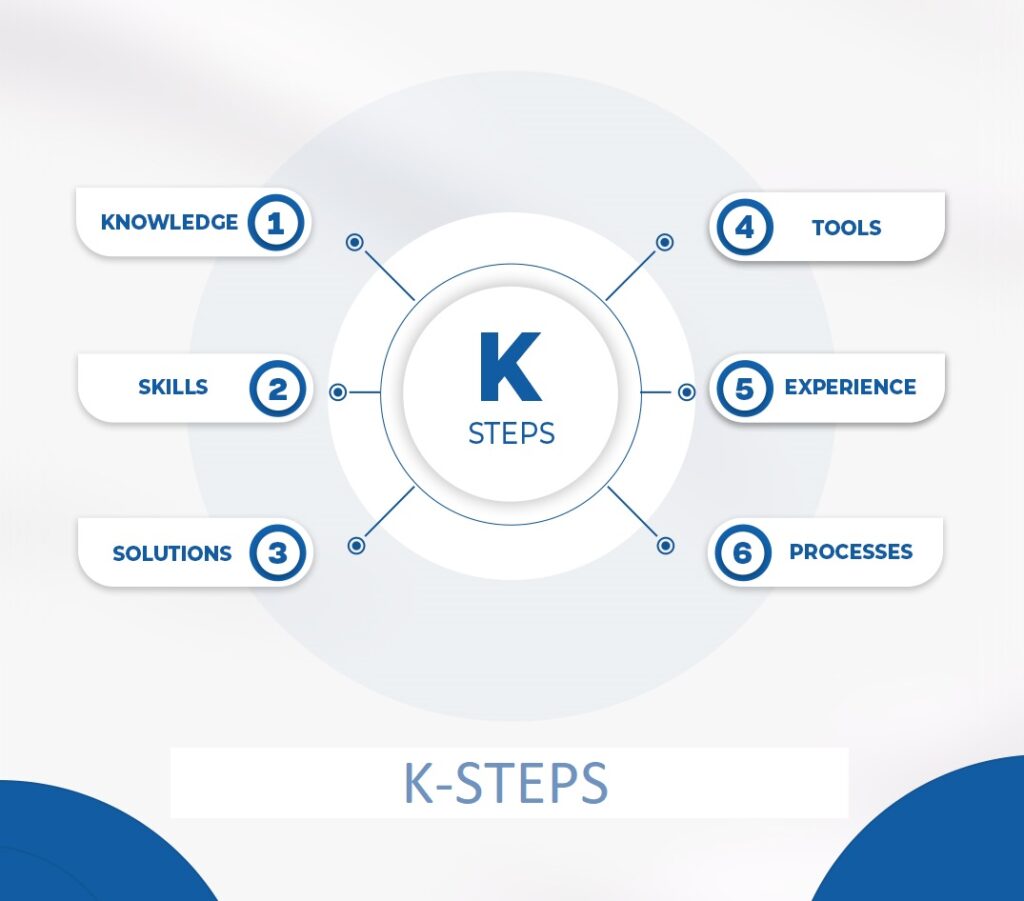
Each pillar of K-STEPS represents a distinct dimension of your expertise. Together, they form the complete architecture of your professional visibility strategy. Understanding each pillar and knowing how to activate it through content and conversation is what separates a scattered presence from a commanding one.
- Knowledge
Knowledge refers to what you understand conceptually. This includes industry insights, principles, frameworks, research, and the theoretical foundations that underpin your field. Knowledge-based content establishes credibility and demonstrates intellectual depth.
A healthcare leader might share insights about patient engagement models. A real estate professional might explain market trends and valuation strategies. A finance executive might break down risk frameworks for a non-technical audience. Whatever your field, knowledge-based content builds trust through education. It signals that you think deeply and stay current, which is the cornerstone of lasting professional visibility.
- Skills
Skills represent your practical capabilities: the competencies that allow you to execute effectively. While knowledge explains what is true, skills demonstrate what you can actually do. This pillar shifts your brand from theoretical to demonstrably capable.
A consultant may showcase negotiation skills. A marketer may highlight campaign optimisation expertise. A medical professional may demonstrate diagnostic reasoning. Communicating your skills through content and conversation signals competence and invites confidence from your audience.
- Tools
Tools refer to the systems, platforms, software, and resources you use to deliver results. This pillar makes your expertise tangible. It moves beyond ideas and into the practical machinery of how you work. Sharing your tools shows that your expertise is operational, not just theoretical.
A content strategist might discuss analytics platforms and automation tools. A healthcare organisation might highlight clinical systems. A real estate firm might demonstrate CRM and sales tracking workflows. Talking about tools builds credibility by showing that your results are driven by deliberate, reproducible systems. It also gives your audience something concrete to associate with your professional visibility: not just ideas, but the infrastructure behind them.
- Experiences
Experiences are your real-world stories, case studies, wins, failures, and lessons learned. This pillar humanises expertise. It creates relatability and emotional connection: qualities that no amount of theoretical knowledge can manufacture.
Professionals who share experiences move beyond theory. They demonstrate that their insights are grounded in reality and tested under pressure. This builds trust at a deeper level than knowledge or skills alone. People do not just want to know that you are smart. They want to know that you have been through something and come out wiser. Experience-based content is one of the most underused assets in personal brand creation, and one of the most powerful tools for genuine professional visibility.
- Processes
Processes describe how you think and how you approach problems. This includes decision-making frameworks, step-by-step systems, methodologies, and workflows. It answers one of the most powerful questions any professional can address: not just what you do, but how you do it.
This pillar is especially powerful for consultants, founders, and executives. When you explain your process, you demonstrate strategic maturity. It shows that your results are not accidental or one-off. They are repeatable, teachable, and scalable. Process content positions you as a systems thinker, which is among the most valued professional identities in any industry.
- Solutions
Solutions focus on outcomes. This pillar answers the most important question in business: what changes because you exist? Solutions highlight transformation, results, measurable improvements, and tangible impact.
While knowledge and skills show that you are capable, solutions show that you deliver. This is where professional visibility becomes undeniable. Decision-makers invest in professionals who solve problems, and solution-oriented content makes the return on investment of your expertise immediately clear. Lead with outcomes, and your personal brand speaks directly to the business priorities of your ideal audience.
How Structure Increases Professional Visibility
Authority in any professional field is not simply the product of experience or skill. It is the product of organised, consistently communicated expertise. The K-STEPS framework accelerates authority-building by giving professionals a structured lens through which to view and express everything they know.
When your audience sees you communicating across multiple pillars, sharing deep knowledge, demonstrating practical skills, revealing your tools, telling experience-backed stories, walking through your processes, and showcasing real solutions, they develop a comprehensive and compelling picture of your expertise. That multi-dimensional view is what creates lasting professional visibility, not any single brilliant post.
Personal Brand Marketing Strategies for Professional Visibility
Having a clear personal brand creation model is necessary but not sufficient. The model must be activated through consistent, intentional marketing. Below are the core strategies that transform brand clarity into real-world professional visibility.
Content Strategy
Content is the primary vehicle for professional visibility. Through articles, posts, videos, newsletters, and podcasts, you demonstrate expertise at scale, reaching people you have never met and building trust before any direct conversation begins.
An effective content strategy starts with clarity on your audience: who are they, what challenges do they face, and what transformation are they seeking? From that foundation, you use K-STEPS to ensure content depth and diversity. Rotate across pillars: share a knowledge insight one week, a process breakdown the next, an experience-backed story after that. This rotation prevents repetition, deepens your perceived expertise, and keeps your audience engaged over time.
Consistency matters more than volume. A professional who publishes one deeply valuable piece of content per week, year after year, will build more professional visibility than someone who posts three times daily for a month and then disappears. Content strategy is a long game. The professionals who win treat it as a habit, not a campaign, and they treat personal brand creation as an ongoing practice, not a one-time project.
LinkedIn Authority Building
For most professionals, LinkedIn is the highest-leverage platform for building professional visibility. With its algorithm that rewards expertise-driven content, LinkedIn offers unparalleled access to decision-makers, hiring managers, clients, and peers across every major industry.
LinkedIn authority building begins with profile optimisation: a headline that communicates your specific expertise and value proposition rather than just your job title, a summary that tells a compelling story of your background and impact, and a portfolio of featured content that demonstrates the depth of your knowledge. Beyond the profile, authority is built through consistent publishing, thoughtful commenting on industry conversations, and direct engagement with your ideal audience.
The professionals who dominate LinkedIn are not necessarily the most senior or the most credentialed. They are the ones who show up consistently, share genuinely useful insights, and engage with their community in a way that feels human and substantive. K-STEPS provides the content depth needed to sustain this kind of presence over the long term.
Consistency Frameworks
The single biggest threat to professional visibility is inconsistency. Most professionals start with enthusiasm and fade within weeks because they lack a system. A consistency framework removes the friction from content creation by pre-deciding what you will create, how often, and from which pillar.
A practical approach is to assign each week of the month to a different K-STEPS pillar. Week one: Knowledge. Week two: Skills. Week three: Experiences. Week four: Solutions. Over the course of a year, this approach produces a rich, multi-dimensional content library that covers your personal brand creation journey from every angle, without requiring you to reinvent your strategy each week.
How to Build Professional Visibility Step by Step
Professional visibility does not happen by accident. It is the result of four interconnected disciplines, each of which must be practised with intention and consistency.
Step 1: Clarity
Before you can be visible, you must be clear. Clarity begins with answering three foundational questions: Who do you serve? What specific problem do you solve? And what makes your approach distinctly yours? Without clear answers, your content and communication will feel generic, and generic is invisible.
Use K-STEPS as your clarity tool. Map out your expertise across all six pillars. What do you know deeply? What can you do that others cannot? What tools define your practice? What experiences have shaped your perspective? What process do you follow? And what outcomes do you consistently produce? This exercise alone will give you more content ideas and professional visibility clarity than most professionals discover in years of guesswork.
Step 2: Content
Once you have clarity, you must translate it into content. Content is the language of professional visibility. Every piece you create is a signal to your audience. It tells them what you know, how you think, and whether you are worth paying attention to.
Start with formats that feel natural. If you write easily, begin with LinkedIn articles or posts. If you speak fluently, explore video or podcasting. If you are systematic, create frameworks and visual explainers. The best content is the content you will actually produce. Perfection is far less important than consistency, and consistency is what compounds into professional visibility over time.
Step 3: Distribution
Content without distribution is a tree falling in an empty forest. Distribution is the active process of getting your content in front of the right people. No personal brand creation strategy is complete without it. Choose the right platforms for your audience, engage with communities where your ideal clients or collaborators gather, and amplify your best content through strategic sharing. For a deeper look at how to amplify reach on LinkedIn specifically, see LinkedIn Content Strategy: How to Build Authority Through Consistent Posting.
Distribution also means building relationships with other visible professionals who share your audience. Strategic collaboration through co-authoring, cross-promotion, joint webinars, or podcast guest appearances can dramatically accelerate your professional visibility by borrowing the trust others have already built with their audiences.
Step 4: Positioning
Positioning is the strategic decision about where you stand in the landscape of your industry. It is not just what you do. It is how you are perceived relative to others who do similar things. Strong positioning answers the question: why you, and not someone else?
Effective positioning requires a specific angle: a point of view that is distinct, defensible, and deeply relevant to your target audience. It might be a methodology you have developed, an underserved niche you serve, a contrarian perspective you hold, or a unique combination of expertise that no one else in your space can replicate. Whatever your angle, make it explicit, communicate it consistently, and let it guide every major personal brand decision you make.
Common Mistakes That Undermine Professional Visibility
Even well-intentioned professionals make predictable mistakes that undermine their brand-building efforts. Recognising these patterns is the first step to avoiding them.
Mistake 1: Random Posting
Random posting is the personal branding equivalent of shouting into a crowd with no clear message. When professionals post without a strategic framework, sharing unrelated thoughts, jumping between topics, or reacting to whatever is trending, they create confusion rather than clarity. Their audience cannot form a coherent picture of their expertise, and professional visibility suffers as a result.
The fix is structure. With K-STEPS, every piece of content has a clear purpose and a clear pillar. There is no more staring at a blank screen wondering what to post. There is only the question of which dimension of your personal brand creation strategy to illuminate today.
Mistake 2: No Differentiation
Many professionals present themselves in exactly the same way as everyone else in their industry. They use the same buzzwords, make the same claims, and offer the same generic value propositions. The result is that they become interchangeable with dozens of competitors, and interchangeable professionals are chosen on price, not value.
Differentiation requires courage. It means taking a stand, sharing a perspective, and making clear choices about who you serve and how. That specificity feels risky. In practice, it is the safest strategy for building lasting professional visibility.
Mistake 3: No Positioning Angle
Without a clear positioning angle, a personal brand is simply a resume: a list of credentials and past roles that tells people where you have been, not why you are uniquely suited to solve their problem today. Positioning is the bridge between your expertise and the market’s needs.
A positioning angle can take many forms: a signature framework, a specific industry focus, a unique methodology, a contrarian viewpoint, or a distinctive combination of disciplines. Whatever form it takes, it must be visible, consistent, and genuinely owned by you. Personal brand creation without a positioning angle produces noise. With one, it produces professional visibility that compounds over time.
Final Framework: Turning Expertise Into Authority with K-STEPS
Everything in this guide leads to a single, actionable conclusion: expertise does not automatically become authority. It must be organised, articulated, and consistently communicated. K-STEPS is the operational system that makes both professional visibility and personal brand creation possible at scale.
By mapping your professional identity across the six pillars, Knowledge, Skills, Tools, Experiences, Processes, and Solutions, you gain an inexhaustible source of content, a clear competitive positioning, and a structured approach to communicating your value in every context: on LinkedIn, in client conversations, during speaking engagements, and in the boardroom.
K-STEPS is not a shortcut. It is a system. And systems, applied with consistency and intention, produce compounding results. The professional who works this framework for twelve months will look back on a body of work, a reputation, and a level of professional visibility that cannot be replicated by anyone who spent that same year posting randomly and hoping for the best.
The six pillars are not just content categories. They are six lenses through which every expert can examine and express their expertise more fully. Use them to answer the questions your audience is already asking. Use them to demonstrate the full depth of what you bring. Use them to make your expertise impossible to ignore.
Professional visibility is not built overnight. But with the right framework, the right personal brand creation strategy, and the right consistency, it is built inevitably. K-STEPS is your blueprint. The expertise is already yours. Now it is time to make it visible.