How to Write a Personal Branding Statement (With Fill-in-the-Blank Template)

A personal branding statement is one or two sentences that say who you help, what you help them do, and why you are the person to ask. It is not a slogan, and it is not your biography. It is a working tool: it keeps your posts, your profile and your conversations pointing in the same direction.
This guide gives you a simple template, three worked examples, and a way to test whether your statement actually works. You can write a first version in about fifteen minutes.
- A good statement names a specific audience, a specific outcome, and a reason to believe you.
- Write it in plain words you would say aloud, then trim.
- Test it on three people. If they cannot repeat it back, rewrite it.
1 What a branding statement is for
People meet you in pieces: a LinkedIn headline, a post, an introduction at an event, a line in a proposal. Without a shared message, each piece says something different, and nobody forms a clear picture.
A statement fixes that. You use it as the source for your headline, the opening of your About section, your spoken introduction, and the theme behind your content. You will rarely publish it word for word. Its job is to keep everything else consistent.

2 The simple template
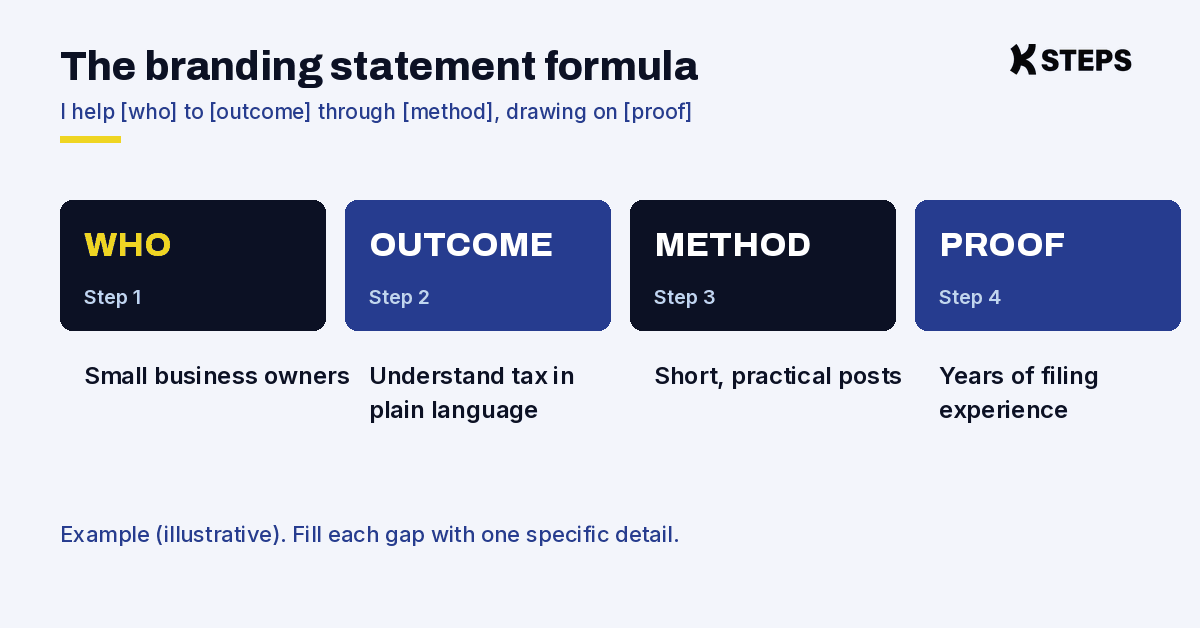
Start with this structure and fill the gaps.
- Who: the specific people you serve, such as “first-time managers in Nigerian banks”.
- Outcome: what changes for them, such as “run their first team meeting with confidence”.
- Method: how you help, such as “through short practical lessons and one-to-one coaching”.
- Proof: why they should believe you, such as “after ten years managing teams in retail banking”.
Put it together as one sentence: “I help [who] to [outcome] through [method], drawing on [proof].”
3 Three worked examples
These are illustrative, written for clarity rather than as real clients.
The HR consultant. “I help growing Nigerian businesses hire people who stay, using structured interviews and clear probation reviews, based on twelve years in recruitment.”
The accountant. “I help small business owners understand their tax obligations in plain language, so they file on time and keep more of what they earn.”
The pastor. “I help families grow in faith through clear, practical teaching that reaches them every day of the week, not just on Sunday.”
Notice what each one avoids. None says “passionate”, “dynamic” or “results-driven”. Each names a person, a change and a method.
If your statement could describe anyone, it describes no one.
4 Make it specific without boxing yourself in
Many people avoid specifics because they fear losing opportunities. In practice the opposite happens. A narrow statement is easier to remember and easier to recommend. “Great with startups” gets forgotten. “Helps early-stage founders in Lagos write their first investor update” gets passed on.
You can always widen later. Start narrow, learn who responds, and adjust the statement using what you see.
5 Write it in your own voice
Read your draft aloud. If you would never say it to a client over coffee, change it. Replace abstract phrases with the words your audience actually uses. If your clients say “get paid on time”, do not write “optimise cash flow”.
A statement in your real voice also makes writing posts easier, because you already know how you sound.
6 Test it on three people
Pick three people from your target audience, or close to it. Say your statement and ask two questions: “What do you think I do?” and “Who would you send to me?”
Their answers tell you more than your own review. If they describe something different from what you meant, the statement needs work. If they name the right type of person, you are close.
- Names a specific audience
- Describes a change, not just a job title
- Gives one reason to believe you
- Uses words you would say aloud
- Fits in two sentences or fewer
- Passes the three-person test
7 Where to use your statement
Once you have it, put it to work.
- LinkedIn headline and About section: use the audience and outcome in your headline and expand the full statement in the first lines of About.
- Content themes: list three topics that prove the statement is true, and write about them repeatedly.
- Introductions: keep a spoken version that takes under ten seconds.
- Proposals and bios: reuse the same wording so your message stays consistent.
8 Common mistakes to avoid
- Writing for everyone. A broad audience produces a vague message.
- Listing titles instead of value. Readers care what you change for them.
- Using buzzwords. Words that sound impressive often say nothing.
- Claiming what you cannot prove. Keep the proof honest and specific.
- Never revisiting it. Review your statement every six months as your work changes.
Your statement is a starting point. Your posts are where people learn if it is true.
A worked rewrite, step by step
Most weak statements fail in the same way: they list a job title and a few adjectives. Here is how one gets sharper, using an invented example for illustration.
First draft: “I am a passionate marketing professional with many years of experience.”
This could describe thousands of people. It names no audience, no problem and no outcome.
Second draft: “I help small businesses with their marketing.”
Better, but “small businesses” and “marketing” are both very wide.
Third draft: “I help owner-run restaurants fill quiet weekday tables, using simple local promotions.”
Now a reader can picture the client, the problem and the method. A restaurant owner knows at once whether this is for them. Someone who is not a restaurant owner also knows, and that is fine. A statement works by including the right people clearly, not by including everyone.
The questions behind a good statement
If the template feels stuck, answer these questions out loud first, then write down what you said.
- Who did I help most recently, and what was their situation?
- What did they struggle with before we worked together?
- What changed for them afterwards, in plain words?
- What do people thank me for, again and again?
- What do I enjoy enough to do for another five years?
The last question matters more than it looks. A statement you outgrow in six months becomes a burden. Choose a direction that you would still be glad to be known for.
How often to revisit it
Treat your statement as a draft with a review date. Put a reminder in your calendar for three months from now. At the review, read your last ten posts and ask whether they match the statement. If your posts have drifted toward a different audience or topic, you have two options: update the statement to match reality, or steer your posts back. Either is fine. The mismatch is the thing to fix.
Using the statement in a post
A statement does not belong only in your profile. Turn it into a short post that explains why you do this work. Start with a specific moment, such as the client who made you realise the problem, then state your focus in one sentence. People connect with a reason far more than with a slogan.
Keep it under two hundred words, avoid claims you cannot support, and read it aloud before publishing. If you stumble on a sentence while reading, a reader will too.

Frequently Asked Questions
How long should a personal branding statement be?
One or two sentences. If you need a paragraph, you have not yet decided what matters most.
Is a branding statement the same as a tagline?
No. A tagline is a short public phrase. A statement is a working description for you, which you use to shape taglines, headlines and posts.
Can I change my statement later?
Yes, and you should. As your work and audience change, update it. Keep a dated copy so you can see how your focus has moved.
Do I need to publish my statement?
Not word for word. Use it as the basis for your profile, posts and introductions.
Should my statement include my location?
Only if location matters to your work, for example if you serve clients in a particular city. Otherwise it narrows your reach without helping the reader decide.
Can I have more than one statement?
You can adapt the wording for different audiences, but keep one core idea. If you find yourself needing three unrelated statements, you may be trying to build three brands at once.
Share your story with Kay. Kay writes in your voice, and you approve every post.
Turn your statement into postsExamples are illustrative. K-STEPS Technologies Ltd, RC 9300307. testimony@k-steps.com