How to Build a Personal Brand on LinkedIn: A 30-Day Plan

Most professionals do not lack things to say. They lack a plan that fits around a full workday. This 30-day LinkedIn plan breaks the job into four weeks, each with one clear purpose, and asks for about twenty to thirty minutes a day. It is a plan to build a habit and a message, not a promise of numbers.
Follow it as written for one month, then keep what worked.
- Spend week one on your profile and message, not on posting.
- Post three times a week from week two, using a repeatable set of formats.
- Review what happened in week four and decide what to keep.
1 Before you start
Set two simple rules. First, decide who you are talking to, using one sentence. Second, choose three topics you will return to all month. If you have written a branding statement, use it. If not, write a rough one now and improve it later.
Then block time. Twenty minutes a day, at the same hour, works better than two hours on a Sunday. Put it in your calendar like a meeting.

2 Week one: set up your profile
You are not posting yet. You are making sure that anyone who finds you after a post understands you quickly.
- Clear, recent profile photo
- Headline that names who you help and how
- About section that opens with the person you serve
- Featured section with one or two pieces of your best work
- Contact details and a clear next step
- Connect with ten people you already know in your field
Spend the last two days of the week drafting your first six posts. Having a small stock removes the pressure of writing from scratch every morning.
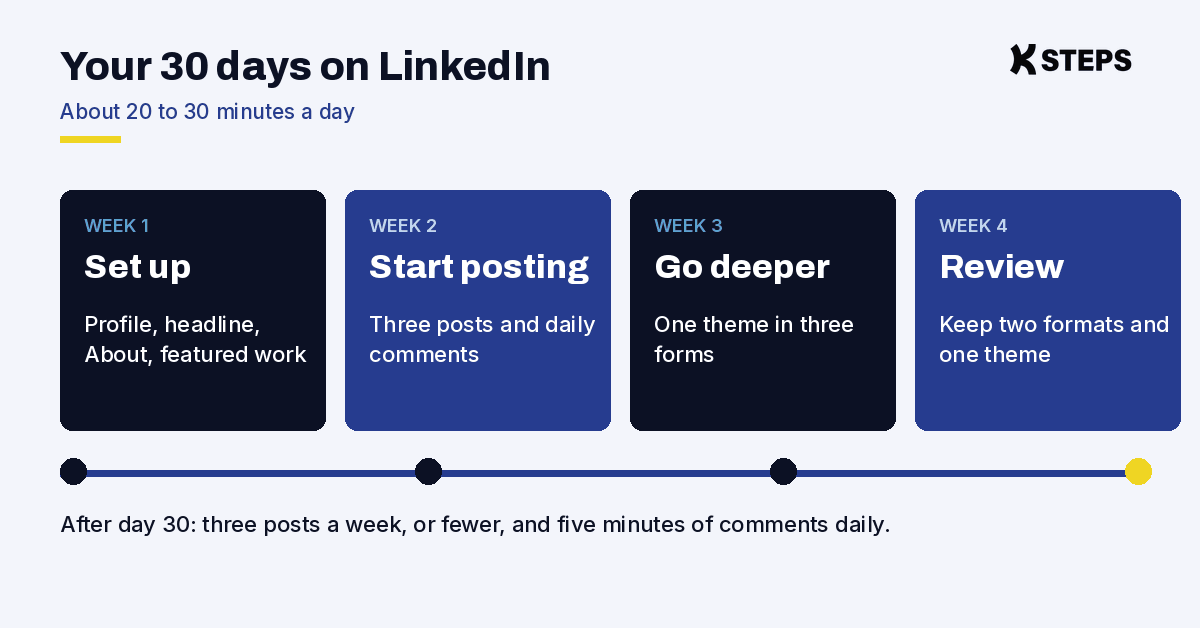
3 Week two: start posting and commenting
Publish three posts this week. Use a mix of formats so you can see which your audience prefers.
- A lesson: one thing you have learned in your work, explained simply.
- A story: a short account of a real situation, with what you did and what happened.
- A question: something you want your audience to answer from their own experience.
On the days you do not post, spend ten minutes leaving thoughtful comments on posts from people in your field. Comments reach audiences you have not yet built, and they show how you think.

4 Week three: go deeper on one theme
Choose your strongest topic from week two, the one that drew the most replies or questions, and write three posts that explore different angles of it.
Try a numbered list, a before-and-after, and a short explanation of a common mistake. Repeating one theme in three forms helps people link your name with that subject.
Say one thing in three ways. That is how people remember it.
5 Week four: review and decide
Stop and look at what happened. Do not judge yourself by a single number. Look for patterns.
- List your posts and mark which brought replies, messages or profile visits.
- Note which topics people asked follow-up questions about.
- Check what took the longest to write and what felt natural.
- Pick two formats and one theme to continue.
- Write next month’s first six post ideas.

6 A simple weekly rhythm to keep
After day 30, you do not need to repeat the plan. Keep a light rhythm.
- Monday: publish one post.
- Wednesday: publish one post.
- Friday: publish one post.
- Every day: five minutes of comments on posts from your audience.
Scale up or down based on your time. A steady two posts a week beats an ambitious schedule you abandon in a fortnight.
7 What to do when you run out of ideas
- Answer a question a client asked you this week.
- Explain a term from your field that outsiders find confusing.
- Share a mistake and what you changed afterwards.
- Describe your process for one task, step by step.
- Reply in a post to a comment that deserved a longer answer.
Keep a running note on your phone. Ideas arrive during ordinary work, and a note costs you ten seconds.
8 Mistakes that slow people down
- Posting without a message. Random posts build nothing.
- Chasing every trend. Stay with your three topics.
- Never replying to comments. Conversation is where relationships begin.
- Quitting after two weeks. The first month is for learning, not judging.
- Over-polishing. A clear, honest post you publish beats a perfect one you do not.
The plan you follow beats the plan you admire.
How to measure the thirty days
Keep the measurement simple, or you will stop doing it. A small notes file or a page in a notebook is enough. Each Friday, write down four things:
- How many posts you published this week.
- How many meaningful comments you left on other people’s posts.
- Which post got the most replies or messages, and what it was about.
- One thing you noticed about what your audience wanted.
Resist the urge to track every number the platform offers. Views and likes are easy to see but tell you little about whether the right people are paying attention. A single message from someone in your target audience is worth more than a hundred passing reactions.
A realistic time budget
The plan asks for twenty to thirty minutes a day. Here is one way that time can break down on a typical weekday.
- Five minutes: read your feed and pick two posts worth commenting on.
- Ten minutes: write your comments thoughtfully, adding a real point rather than praise alone.
- Ten to fifteen minutes: draft or polish the day’s post, if it is a posting day.
On non-posting days the time drops to around fifteen minutes. If your week is busy, shift tasks rather than skipping them. A shorter session done every day does more for your visibility than a long one done once.
What to do after day thirty
The end of the plan is a decision point, not a finish line. Look back at your notes and choose one of three paths.
- Continue as is. If the rhythm felt comfortable and you saw some response, keep going for another month with the same themes.
- Narrow the focus. If one topic clearly drew more interest, make it the main theme and reduce the others.
- Change the format. If writing felt heavy, try short lists, photo captions or voice-to-text drafts.
Whichever you choose, write the next thirty days’ outline before you stop. Momentum is easiest to keep when the next step is already decided.
A note on privacy and your employer
If you are employed, read your company’s social media policy before you start. Share what you know about your field, not anything confidential about your employer or clients. When in doubt, leave it out. A reputation built carefully over months can be damaged by a single careless post.

Frequently Asked Questions
How many times a week should I post on LinkedIn?
Two to three well-considered posts a week is a sensible target for most professionals. Choose a number you can sustain.
Should I post at a specific time?
Test it. Try mornings for a couple of weeks and evenings for a couple more, then see where your audience responds. There is no universal best time.
Do I need to write long posts?
No. Short, clear posts work well. Use length when the idea needs it.
What if nobody reacts?
Early posts often get little response while your network is small. Keep commenting on others’ posts, review the topics in week four, and adjust.
What if I miss several days in a row?
Restart on the next day without trying to catch up. The plan is a rhythm, not a test, and a short gap does not undo earlier work.
Do I need to post every day?
No. The plan mixes posting with commenting and review. Several days are about reading and replying rather than publishing.
Tell Kay your story and your topics. Kay drafts the posts in your voice, and you approve every one before it goes out.
Skip the blank pageThis plan is a starting framework, not a guarantee of results. K-STEPS Technologies Ltd, RC 9300307. testimony@k-steps.com