How to Create a Personal Brand on LinkedIn: Step-by-Step for Beginners

You Already Have a Personal Brand, You Just Haven’t Shaped It Yet
Creating a personal brand on LinkedIn does not start with a blank page , it starts with what you already have. Right now, anyone who searches your name forms an impression, whether you planned it or not. You do not need to build from scratch. You need to take control of what is already out there and shape it with intention.
If how to create a personal brand makes you think of influencers, self-promotion, or spending hours crafting polished posts ,take a breath, because that is not what this is about. Instead, creating a personal brand on LinkedIn is fundamentally about reputation management. In other words, it is about consciously deciding what you want to be known for, and then making sure the right people understand that value when they look you up.
This guide is beginner-friendly, practical, and built around one principle: clarity beats perfection every time. By the end, you will know exactly how to create your personal brand on LinkedIn , step by step, without the overwhelm.
What Does ‘Personal Brand’ Actually Mean?
The Simplest Definition (With Examples)
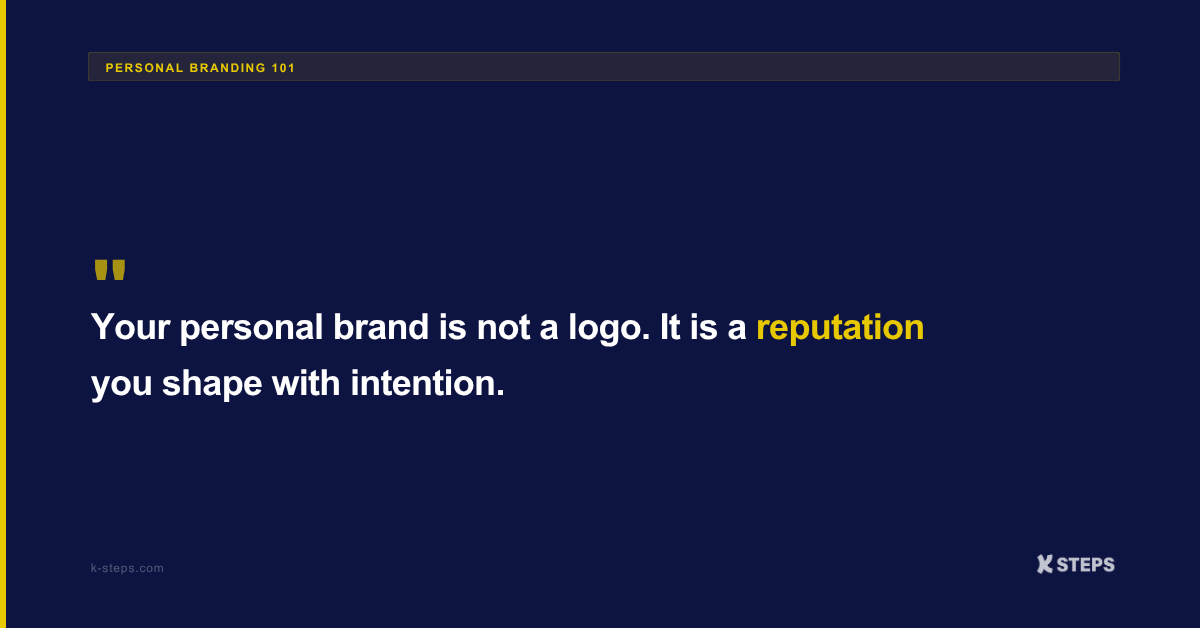
Your personal brand is the specific impression people hold of you in a professional context. In other words, it is the answer to the question: what is this person known for? It is not a logo or a tagline. Instead, it is the mental shortcut people use when they think of you.
To make this concrete, consider two examples. One professional might be known as the HR leader who speaks plainly about workplace culture. Another might, by contrast, be the finance manager who makes complex data approachable. Neither of these is a manufactured persona, rather, both are clear, consistent signals of genuine expertise. At its core, that is all a personal brand ever is.
Personal Brand vs. Personal Marketing
Personal branding is about defining who you are and what you stand for. Personal marketing is about communicating that to the right audience. You need both , but most beginners skip the defining step and jump straight to posting, which is why so much LinkedIn content feels hollow.
Think of it this way: your brand is the substance. Your LinkedIn profile and content are the signal. If there is no substance, the signal has nothing to carry.
Why Everyone on LinkedIn Has a Brand Whether They Like It or Not
A silent LinkedIn profile still sends a message. It says: this person is not particularly active, engaged, or invested in their professional visibility. For most professionals in 2026, an unoptimized profile is quietly costing them opportunities they will never even know existed, recruiters scroll past, potential clients cannot find them, and collaborators choose someone whose expertise they can actually see.
Personal brand identity is not about becoming someone you are not. It is about making sure the person you already are is clearly visible to the people who need to find you.
Before You Start: 3 Foundation Questions to Answer
Before you touch a single word of your LinkedIn profile, sit with these three questions and write your answers down. Everything else in how to build your personal brand strategy flows from here.

Question 1: What Do I Want to Be Known For?
This is your expertise anchor, the one or two things you want associated with your name. It does not have to be your entire job description. A helpful exercise: write down the last five meaningful professional conversations you had. What topics kept coming up? What were you asked about? What did you explain or solve? The common thread is often your brand’s core territory.
Question 2: Who Is My Target Audience on LinkedIn?
Personal brand goals without a target audience are just noise. Get specific: recruiters at companies you admire, potential clients in a particular sector, peers you want to collaborate with, or future employers in a defined niche. The more specific your answer, the sharper every subsequent brand decision becomes , your headline, content topics, tone, and connection strategy all depend on it.
Question 3: What Makes My Perspective or Experience Unique?
Most beginners assume they are not interesting or experienced enough to have a genuine point of view. In reality, however, they are wrong. Uniqueness on LinkedIn is rarely about having more experience than everyone else. Rather, it is about your specific combination: the industries you have worked across, the problems you have solved, and the mistakes you have learned from. To illustrate, consider a marketing manager with a background in clinical psychology, or a finance director who ran a small business first. Far from being irrelevant detours, these combinations are, in fact, the raw material of a distinctive personal brand identity.
How to Create Your Personal Brand on LinkedIn: 7 Steps
Step 1: Audit Your Current LinkedIn Profile
Before building anything new, assess what you already have. Read your profile with fresh eyes, or ask someone who does not know you well to tell you what impression it gives them. Look specifically at:
- Your headline: does it communicate your value, or just your job title?
- Your About section: does it speak to your target audience, or is it a CV summary?
- Your profile photo and banner: do they look professional and on-brand?
- Your featured section: is it empty, or actively showcasing your best work?
- Your experience section: do entries show impact and results, or just duties?
Write down what is missing, what is vague, and what needs to go. This audit becomes your personal brand building roadmap.
Step 2: Define Your Brand Statement (Who You Help + How + Result)
Your brand statement is the single most useful tool in your personal brand toolkit. It is a one or two sentence summary that answers three things: who you help, how you help them, and what result they get. You will use it in your headline, your About section, your email signature, and any time someone asks what you do.

The formula is simple:
| I help | [your target audience] |
| achieve | [the result they want] |
| through | [your method or expertise] |
Here are three examples across different roles:
- ‘I help early-stage SaaS founders build content strategies that generate pipeline without a full marketing team.’
- ‘I help HR leaders design onboarding experiences that cut first-year turnover by creating genuine belonging from day one.’
- ‘I help mid-career professionals transition into product management by translating their existing experience into a language hiring teams understand.’
Notice that none of these are vague. None of them say ‘I help businesses grow’ or ‘I’m passionate about making a difference.’ They are specific, outcome-focused, and immediately tell the reader whether this person is relevant to them. That is the goal.
Use the template below to draft yours:
YOUR BRAND STATEMENT TEMPLATE
I help _______________________________ [your target audience]
achieve _____________________________ [the result they want]
through _____________________________ [your method or expertise].
Step 3: Rewrite Your Headline and About Section
Armed with your brand statement, rewriting your headline and About section becomes significantly easier , because you know exactly what you are trying to communicate.
Your headline is the most visible text on your profile. It appears in search results, in comments, in connection requests, and in suggested contacts. Do not waste it on your job title alone. Use the space to communicate your positioning. A simple formula: [Your role] | [Who you help] | [The result or expertise you offer].
Your About section is your brand narrative in long form. Open with a hook that speaks directly to your target reader , not a sentence about yourself, but a sentence about them or the problem you solve. Then move through your origin story (why you do what you do), your core expertise, the results you deliver, and a clear call to action at the end.
Open with a hook that speaks directly to your target reader, not a sentence about yourself, but a sentence about the problem you solve. From there, move through your origin story, core expertise, and the results you deliver, then close with a clear call to action. Keep it in first person and written the way you actually speak. Above all, write for the person reading , not for yourself.”
Step 4: Choose 2–3 Content Topics You Will Consistently Cover
Content is how your brand becomes visible beyond your immediate network. However, random posting builds no brand signal. Instead, define your content pillars: two or three specific topics at the intersection of your expertise and your audience’s interests.

Choose themes you can discuss with genuine depth, that your target audience actively searches for, and that consistently reinforce your brand statement. This pattern recognition is what turns casual scrollers into active followers.
Step 5: Post Your First 5 Brand-Building Pieces of Content
The best content strategy in the world does not matter if it stays in a document. Your first five posts do not need to be perfect, they need to exist. Start with what you already know:
- A lesson you have learned the hard way in your career or industry
- A framework or mental model you use in your daily work
- Your take on a common piece of advice in your field that you disagree with
- A behind-the-scenes look at a decision or project you recently worked on
- A story from your professional journey that illustrates something true about your industry
Publishing imperfect content consistently beats waiting to publish perfect content indefinitely. The algorithm rewards presence , and so do people.
Step 6: Connect Strategically With Your Target Audience
Personal brand goals only compound when they reach the right people. Spend 15 minutes per day building your network intentionally. Search for people you defined in your foundation questions ,recruiters at target companies, potential clients in your niche, peers whose work you respect, and send personalized connection requests that reference something specific.
Additionally, spend time in the comments. Thoughtful, insightful comments on posts by people in your target audience are one of the most underused growth levers on LinkedIn. A well-placed comment on a high-traffic post puts your name and positioning in front of thousands of the right people, for free.
Step 7: Review, Adjust, and Stay Consistent
After your first 30 days of consistent activity, review what happened. Which posts got the most engagement, and why? Who is connecting with you , are they the right people? Is your profile attracting more views? Use what you learn to refine your content topics, sharpen your messaging, and double down on what is working. Personal brand building is an iterative process: the professionals who succeed are not those who got it perfect on the first try, but those who kept showing up and adjusting.
Your LinkedIn Brand Identity Checklist
Use this checklist to audit your LinkedIn presence once you have completed the 7 steps above. Every item represents a brand signal, something that either builds or undermines your credibility in the eyes of every profile visitor.

Profile Completeness Checklist
- Profile photo: professional, warm, good lighting, clear background
- Banner image: on-brand, communicates your niche or positioning
- Headline: communicates who you help and what result you deliver
- About section: hooks, proves expertise, and ends with a CTA
- Featured section: showcases your best content, resources, or work
- Experience entries: show results and impact, not just job duties
- Skills: specific, searchable, and relevant to your positioning
- Custom LinkedIn URL: set to your name (e.g. linkedin.com/in/yourname)
Visual Identity: Photo, Banner, and Consistent Aesthetics
Visual identity on LinkedIn is not about being a designer. It is about consistency.
When someone moves from your profile to a piece of content you have posted to a resource in your Featured section, the visual experience should feel coherent. The same color palette, the same tone, the same level of professionalism.
This consistency is what creates brand recognition , the feeling that someone has encountered you before, even if they have not.
At minimum, ensure your photo and banner work together tonally. If your banner uses blues and white, your content graphics should echo that. If your brand voice is warm and conversational, your photo should reflect that ,a warm, approachable expression rather than a stiff corporate headshot.
Brand Voice: Formal, Conversational, or Educational?
Your brand voice is how you sound when you write ,on your profile, in your posts, in your comments and DMs. It should feel natural to you while also resonating with your audience. There are three broad voice archetypes most LinkedIn brands fall into:
- Formal and authoritative: clear, precise, evidence-based. Works well for legal, finance, academic, and senior leadership brands.
- Conversational and relatable: warm, direct, story-driven. Works well for coaches, HR professionals, founders, and customer-facing roles.
- Educational and analytical: structured, framework-driven, insight-heavy. Works well for consultants, strategists, product leaders, and technical experts.
None is better than the others. The right one is the one that feels true to you and resonates with your specific audience. What you want to avoid is switching between all three depending on your mood ,that inconsistency erodes brand trust faster than anything else.
Mistakes Beginners Make When Starting Their LinkedIn Brand
Knowing what not to do is just as valuable as knowing what to do. These are the three most common mistakes that derail personal branding and how to start efforts before they gain any momentum.
Copying Other People’s Brand Instead of Finding Your Own Voice
The most common trap: a beginner finds a LinkedIn creator they admire and begins replicating their style, format, and topics. The problem is not that learning from others is wrong, it is that wholesale copying produces a diluted version of someone else’s brand, not the beginning of your own. Your audience will always find the original more compelling than the copy. Instead, study what works broadly (strong hooks, clear structure, specific examples) and apply those principles to your own stories, perspective, and expertise.
Over-Polishing and Never Publishing
Perfectionism is the enemy of personal brand building. Many beginners spend weeks rewriting their headline, agonizing over every word of their About section, and drafting posts they never publish because they do not feel ready. The reality is that your brand will never feel ready , it will always be improvable. An imperfect, published brand beats a perfect, invisible one every single time. Start imperfect. Improve in public.
Focusing on Vanity Metrics Instead of Meaningful Engagement
Follower count and post impressions are easy to measure and deeply seductive as indicators of success. But they are almost completely irrelevant to whether your personal brand is actually working. A post that gets 50,000 impressions from people who will never hire you, buy from you, or connect you to an opportunity is worth far less than a post that gets 200 impressions and leads to five meaningful conversations with exactly the right people.
The metrics that actually matter for personal brand goals are:
-
- profile views from relevant people,
- connection requests from your target audience,
- meaningful comments that demonstrate your content is resonating with the right readers, and
- Ultimately inbound messages and opportunities that match your positioning.
Optimize for those. Everything else is noise
Frequently Asked Questions About Creating a Personal Brand on LinkedIn
How long does it take to create a personal brand on LinkedIn?
“For most professionals figuring out how to create a personal brand for on LinkedIn, the initial setup ,defining your positioning, rewriting your profile, and posting your first five pieces of content, takes most professionals one focused weekend or a handful of evenings spread across two weeks. Building momentum and beginning to see meaningful results typically takes 60 to 90 days of consistent activity. The brand itself continues to evolve indefinitely as your career and expertise develop.
Do I need to already be an expert to start building a personal brand on LinkedIn?
No. Personal brand how to start does not require you to be the most experienced person in your field. It requires you to have genuine knowledge, a clear perspective, and something useful to share with a specific audience. Early-career professionals who build their brand from the beginning have a significant advantage over those who wait until they feel ‘expert enough’, which, for most people, never comes.
What is a personal brand statement and why do I need one?
A personal brand statement is a concise articulation of who you help, how you help them, and what result they get. It is the foundation of all your LinkedIn copy: your headline, About section, content, and the way you introduce yourself. Without it, every brand decision becomes harder because you have no clear north star to guide your choices. With it, your entire LinkedIn presence becomes more coherent and compelling immediately.
How often should I post when starting out?
Consistency matters more than frequency, especially at the start. Two to three high-quality posts per week is a sustainable and effective cadence for beginners.
It is better to maintain two excellent posts per week for six months than to post daily for three weeks and then disappear. The LinkedIn algorithm rewards consistent presence over sporadic bursts of activity.
What if I am nervous about self-promotion?
Reframe it. You are not promoting yourself ,you are sharing expertise that helps other people.
Every post that teaches something useful, surfaces a hard-won insight, or helps your audience navigate a challenge they are facing is an act of generosity, not self-promotion. The professionals who understand this distinction are always the ones with the most natural, authentic, and effective LinkedIn brands.
Start Creating Your Personal Brand on LinkedIn Today
Creating a personal brand starts with a single decision: to stop leaving your professional reputation to chance and to start shaping it with intention.

Fortunately, you do not need to have it all figured out before you begin. Simply answer three foundation questions, write a brand statement, update your profile, and post your first piece of content.
From there, the refinement, the growth, and the compounding returns on your visibility all follow naturally. The professionals who build the strongest LinkedIn brands are not the ones who waited until they were ready. Instead, they are the ones who started before they felt ready, learned in public, and kept showing up.
Your personal brand is already out there. The only question now is whether it says what you want it to say.
Ready to go deeper? Read the full Pillar 1 guide — LinkedIn Personal Brand Building: The Complete 2026 Guide : for advanced tactics, content strategy frameworks, and the tools that accelerate every stage of brand growth.
If you are an introvert worried that brand-building is not for you, read Personal Brand for Introverts: Build Professional Visibility Without Burning Out. Everything in this guide applies , with adaptations that make the process sustainable and natural for quieter professionals